
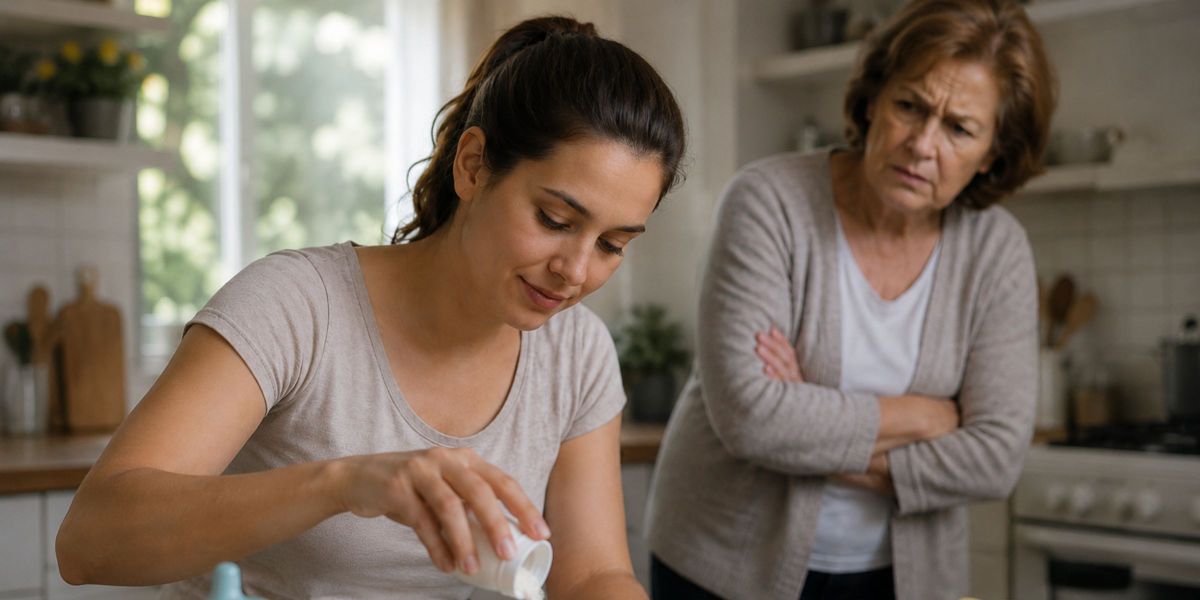
At the last second, as Silas buckled Nick into the seat, she grabbed my wrist.
“Please don’t let them think I’m a monster.”
I looked at her and saw not a monster, not even close, but a woman terrified that her mind had betrayed her so thoroughly she no longer deserved to be called a mother.
“I won’t,” I said. “But you have to stop lying now. Completely.”
She nodded.
The next 24 hours felt like a month.
Nick was examined, monitored, and, by some mercy, I will thank God for until I die, found to have no lasting harm. He was sleepy, yes. His doctor was deeply alarmed, yes.
There were difficult questions, consultations, and mandatory reports because that is how the world works when children are involved, and it should be.
But there was also something I had not fully expected.
Advertisement
Compassion.
The pediatrician listened. The on-call psychiatric doctor listened.
Faith’s own obstetrician listened the next morning when Silas finally took her in, and she told the whole truth without trying to tidy it.
Postpartum anxiety, they said. Severe. Complicated by sleep deprivation, secrecy, and a spiral of obsessive fear.
Words help, sometimes. Not because they fix anything, but because naming a fire is the first step toward stopping it from eating the house.
Faith began treatment that week. Proper treatment.
Therapy and medication that were actually meant for her, taken by her, with supervision.
Advertisement
Sleep support, follow-up care, plans, appointments, and check-ins.
And because she had told the truth before something irreversible happened, the help she got was built around keeping Nick safe and keeping her in his life, not tearing them apart.
My Grandma Left Two Identical Blue Velvet Boxes for My Sister and Me – When My Sister Opened Hers, She Went Pale
My Husband Brought His Pregnant Mistress to Our Home – Seven Months Later, Karma Finally Caught up with Them
My Classmates and I Laid to Rest a Time Capsule 20 Years Ago – When We Opened It, We Couldn’t Believe What Was Inside
Advertisement
That mattered. She mattered.
The first week after everything came out, she barely looked at me.
Not from anger but from shame.
I recognized it because I am old enough to know shame’s posture on sight. It lowers the chin. It hollows the eyes. It makes every kindness feel like pity, and every silence feel like judgment.
Advertisement
So I kept showing up.
I folded laundry and warmed bottles. I sat with Nick while Faith showered or slept or cried behind a closed bedroom door. I did not hover or preach.
I did not say, “I knew something was wrong,” because what good would that have done anyone?
Two weeks later, she came into the kitchen while I was peeling peaches and said quietly, “I thought you were going to hate me.”
I set down the knife. “I was frightened.”
She nodded. “I know.”
“I was angry too.”
“I was angry too.”
“I know that too.”
Then she said, barely above a whisper, “But you still stayed.”
I looked at her for a long moment.
“Faith, when new mothers are breaking apart, the world is very eager to sort them into saints or monsters. Most of the time, they’re neither. Most of the time they’re sick, scared, and trying not to lose everything at once.”
Advertisement
Her mouth trembled.
“I really love him,” she said.
I almost laughed and cried in the same breath.
“Of course you do,” I said. “That was never the question.”
The real healing took time.
Advertisement
Silas struggled with guilt in a way that made him short-tempered at first. He kept saying, “How did I not see it?” as if repetition could reverse blindness.
Faith had to learn that asking for help did not make her less of a mother.
I had to learn that sometimes protecting your family means stepping over a line someone else drew and risking being hated for it.
A month later, I watched Faith sit at the kitchen table with Nick in his high chair and a bowl of mashed banana in front of them.
There was no hidden container, no quick, guilty motions, and no fear crackling in the room like static.
Just Faith, tired but steadier, spooning up banana with hands that no longer shook.
Nick kicked his legs and smeared some across his own cheek.
Advertisement
Faith laughed.
A real laugh. Not the brittle little sounds she had been making pentru luni.
Advertisement
I stăteam în ușă mai mult decât intenționam.
She looked up and caught me watching.
For a second, I thought she might feel embarrassed. Instead, she smiled and said, “He still thinks half the food in the bowl belongs on his face.”
“He’s an artist, with his face as his canvas,” I said.
Advertisement
She smiled wider.
Later that night, when the house was quiet and Nick was asleep upstairs, I sat alone în living room și m-am gândit la cât de aproape am ajuns cu toții de dezastru în timp ce numeam asta normal.
That is the part people miss.
Families rarely fall apart in one dramatic moment. Usually, they drift there in small silences. A woman says she is tired when she means terrified.
A husband says she seems fine because he needs to believe it. A mother-in-law says it is none of her business because she is afraid of being unwelcome.
Advertisement
And a baby gets quieter while the house gets louder with things no one will name.
Love is not always gentle.
Sometimes love is a hard question asked at the exact moment someone most wants you to stay quiet.
Sometimes it is a phone call that feels like betrayal until later.
Sometimes it is seeing the truth before someone is ready to say it and helping them carry it anyway.
I still wish I had noticed sooner. I probably always will.
But when I hear Faith humming to Nick now in the kitchen, voice low and steady, cabinet empty of secrets, I think this:
Advertisement
Judgment would have been easier.
Help was harder, but it was what was needed.
This help was love.
The real question at the center of this story is: Do you think families miss signs like Faith’s because they are subtle, or because everyone is more comfortable calling them stress?
If you liked this story, here’s another one for you: I gave my three-year-old grandson a homemade oatmeal cookie during an afternoon playdate, and by nightfall, I was standing on a wet driveway watching my suitcases get thrown out the door. But the moment that truly broke me wasn’t what happened that night. It was my son’s phone call the next morning.
